Taking a study-abroad agency from sales-led to product-led
Eight tools became one catalog, without stopping a 180-person sales team.
- Context: GrowPro, a study-abroad agency, grew revenue tenfold, but every sale still ran through an advisor and eight tools.
- Finding: in 50+ hours of sales calls, students weren’t after a course but a change of life. For most, the course was the visa.
- Result: the eight tools became one catalog shared by students, advisors and partner agencies, proven in Dubai first. Queries to booking managers fell from 15 to 5 per booking.
- Company
- GrowPro Experience
- Role
- Lead Product Designer
- Years
- 2023-2024
- Scope
- Travel-tech, Marketplace, Sales-led → product-led
At a glance
- 8 → 1 tools turned into one platform
- 3 user types on one catalog
- 50 h+ of sales calls
From six tools (the website, HubSpot for marketing, Compass B2C/B as the CRM, GEMS as the ERP, Partner Portal for B2B and Grower Portal for students) passing each sale from marketing to sales, bookings, visas and support, with consumers, agents, suppliers and ambassadors each coming in through a different tool, to a single GPX platform that agencies and suppliers feed and that serves the consumer directly.
Before and after, role and constraints
Before and after
| Before Sales-led | After Product-led | |
|---|---|---|
| Tools | Eight, one per team | One platform, one catalog |
| Data | Re-typed at every handover | Entered once |
| Buying | A call, a closed proposal, endless WhatsApps | One page, adjusted together |
| Price | A “from” price | The real price, customised in real time |
| After the sale | A department per step | One travel portal |
| Growth | Hiring more advisors | Self-service, agencies and providers |
Before Sales-led
- Tools
- Eight, one per team
- Data
- Re-typed at every handover
- Buying
- A call, a closed proposal, endless WhatsApps
- Price
- A “from” price
- After the sale
- A department per step
- Growth
- Hiring more advisors



After Product-led
- Tools
- One platform, one catalog
- Data
- Entered once
- Buying
- One page, adjusted together
- Price
- The real price, customised in real time
- After the sale
- One travel portal
- Growth
- Self-service, agencies and providers
My role
Lead Product Designer, leading a designer and a researcher, and reporting to the CPO.
Decisions: the what and the how
Some calls were the business’s or product’s, others came from design. Each had an owner for the what and one for the how.
| What and why | How | |
|---|---|---|
| Going product-led | Business | Design: the system map and the research |
| The reframe: a change of life, not a course | Design, from the research | Design |
| A catalog that starts from the goal | Design | Design |
| Cohorts instead of one-offs | Business and design: on the calls, advisors invented urgency | Design: places and real urgency in the storefront |
| One storefront for student and advisor | A hackathon with people from every area | Design |
| The travel portal | Design | Design |
| The HUB, formerly the Experience Pack | Product | Design: the reframe and the name |
| The B2B network | Business | Design: the white label and the provider back office |
| The Dubai MVP | Product | Design: usability tests and iterations |
| Moving advisors over in batches | Product and business | — |
| Metrics and the AARRR funnel | Product | Design: a qualitative review of each step |
Constraints
- The innovator’s dilemma. 180 salespeople and 30 partner agencies sold every day with the old tools. They paid for the change, so the change couldn’t stop them.
- A marketplace with many faces. Students, agencies, providers, and internal sales, booking, visa, support and finance teams.
- Every destination has its own rules. Visas, work permits and course lengths decide what a student can actually buy.
Problem space
01 Opportunity
Behind every sale, eight tools. In front of the student, a process they couldn’t see into.
GrowPro helps young people study and work abroad, in seven countries. In one year, revenue grew tenfold and headcount 120%, but it still sold the same way. GPX replaced that with one catalog that students, partner agencies and providers all work from.
How a sale worked before.
A curve that falls steeply from high conversion when the proposal arrived the same day, keeps falling from 1 to 3 days, and flattens at its lowest from 4 days on.
Hypothesis: with so many tools, processes and people in the way, the student’s experience became confusing.
And if the product did what the advisor did on the call, the proposal would arrive in real time.
02 Research
Listen before designing.
Four sources, one hypothesis.
- Method
- System map, interviews with internal teams, search analytics and 50+ hours of sales calls (Grain)
- Who
- Internal teams, around 50,000 search users and calls between advisors and students
- Output
- System map, concept cloud, feedback river and three archetypes
What we found
01 Students and agencies needed the same catalog.
I mapped actors, journeys, systems and products. Students and agencies needed the same catalog, and every sale got stuck between the CRM and the quoting tool.
02 Every handover started from scratch.
We sat with the teams who made GPX work day to day: sales, bookings, visas, support and finance. Each one worked in its own tool, and the student’s data was typed in again at every handover.
03 Nobody searched the way the catalog was organised.
About 50,000 people used the site search from May to September 2023. Fewer than 9% filtered by country or course type.
04 The why was already recorded.
The analytics showed what people did, not why. The why was in the sales calls: we transcribed 50+ hours, grouped recurring ideas into a concept cloud and placed doubts along the journey in a feedback river.
05 Three archetypes.
The hypothesis held:
- At the back, every sale got stuck between the CRM and the quoting tool.
- At the front, nobody searched the way the catalog was organised.
But the calls went further:
- They didn’t want to go abroad to study.
- They wanted a change of life. For most, the course was the visa.
New north star
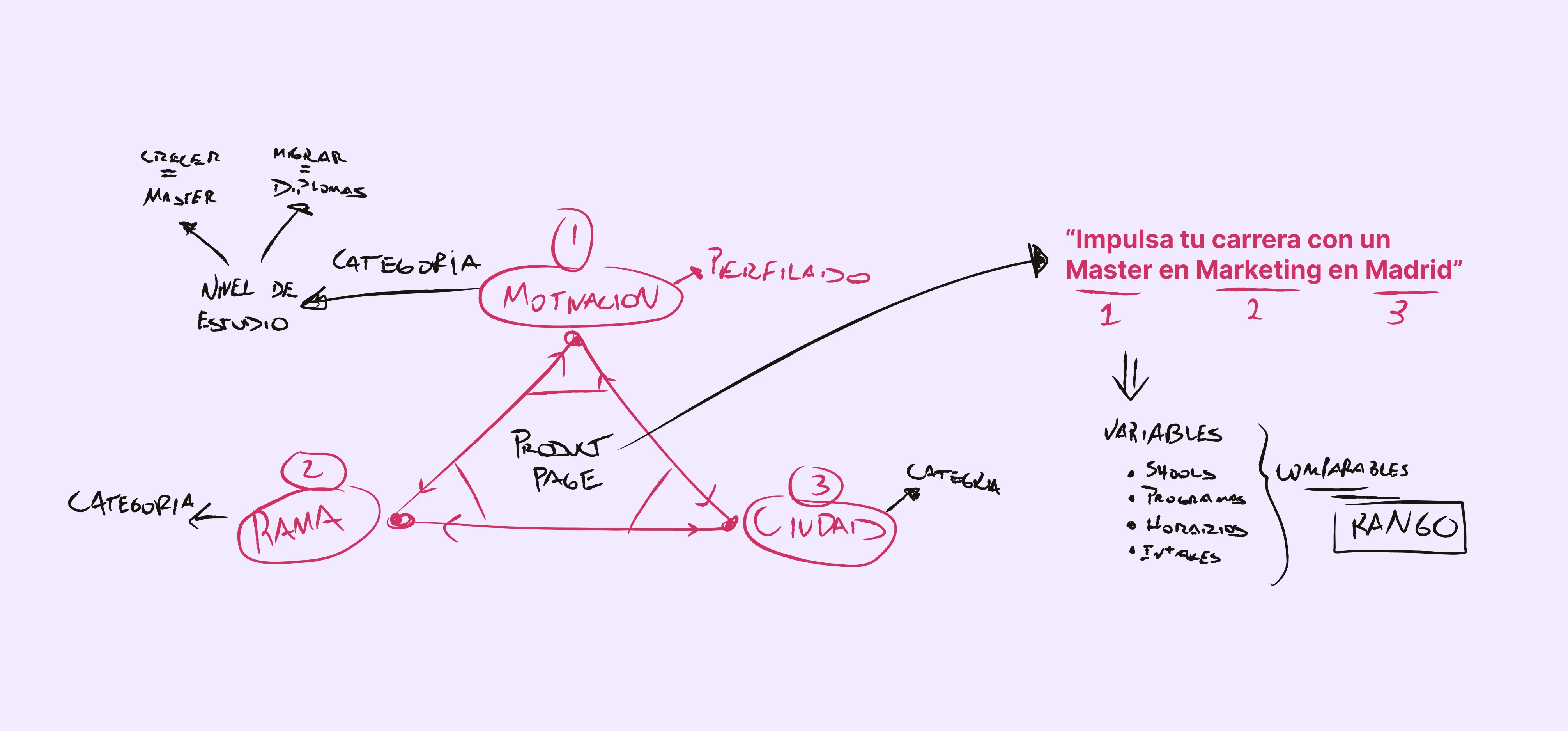
A specific course at a specific school
A catalog that starts from what you want
Solution space
03 Catalog
A user-centred catalog.
We flipped the catalog: the student states the goal and the plan builds around it. The goal is fixed, the route is theirs, and that made self-service possible.
-
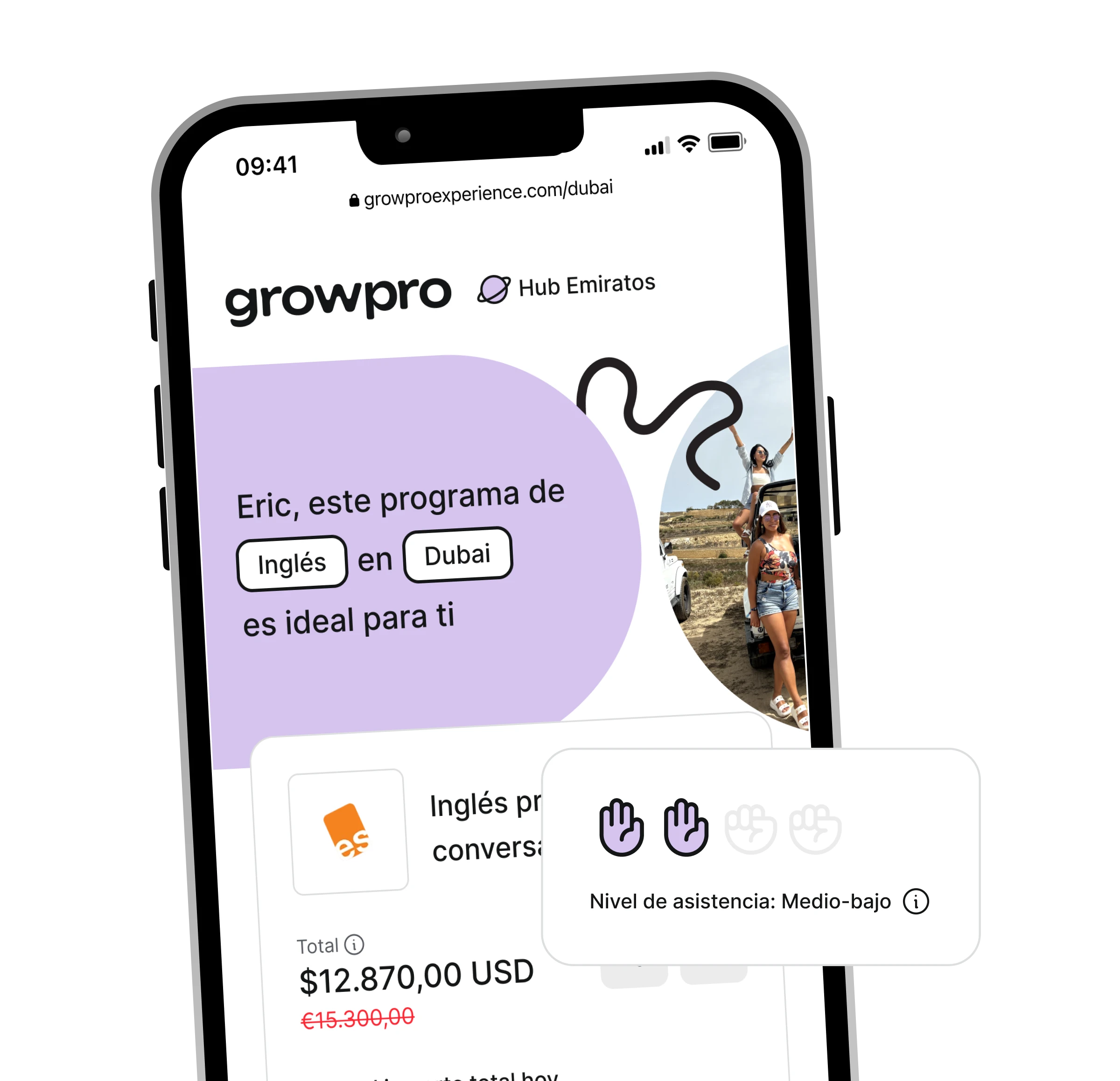
“I want to learn English in Dubai.” That’s the whole search.
-
“Eric, this English programme in Dubai is ideal for you.” One plan, one price.
-
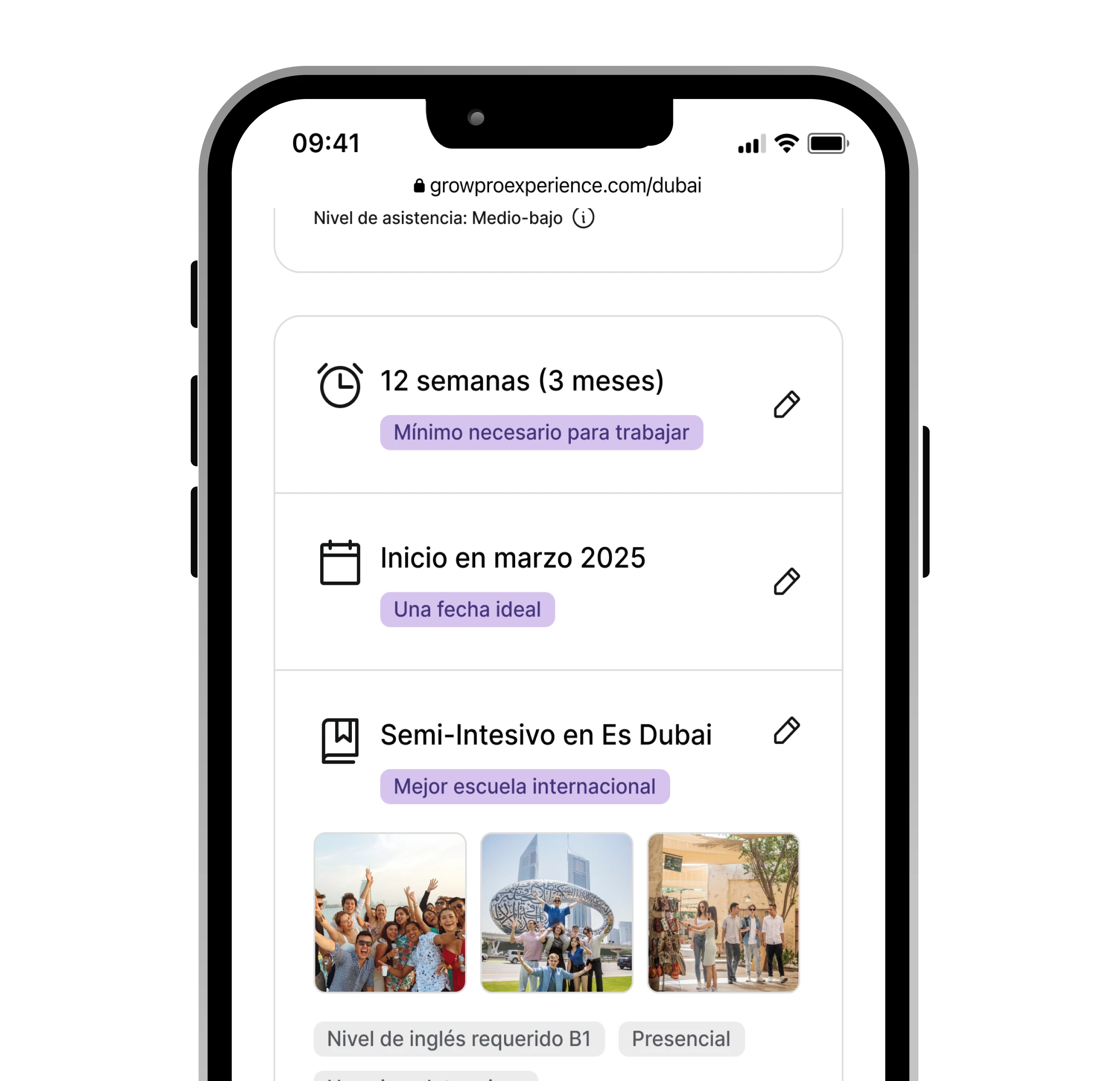
School, length, dates, visa (by nationality), insurance (by country), housing and HUB. The price updates live.
-
Or call an advisor, book a call, or book on your own.
From one-offs to cohorts.
We also changed what we sold: not one experience per student, but cohorts with their own places. On the calls, advisors invented urgency to close; cohorts made it real. A call shared with the business, since it touched marketing, suppliers and the post-sale.
| Before One-shot | After Cohorts | |
|---|---|---|
| The unit | One student, one process | A group with its own places |
| Measuring | Case by case | By group and by season |
| Urgency | Invented on the call | Only X places left |
| Suppliers | Bookings one at a time | Predictable demand |
| Post-sale | Each visa on its own | Visas benchmarked across the group; sales regrouped by category |
04 Storefront
One tool to buy and to sell.
The idea came out of a hackathon with people from every area of the company. If students and advisors needed the same catalog, they could share the same tool.
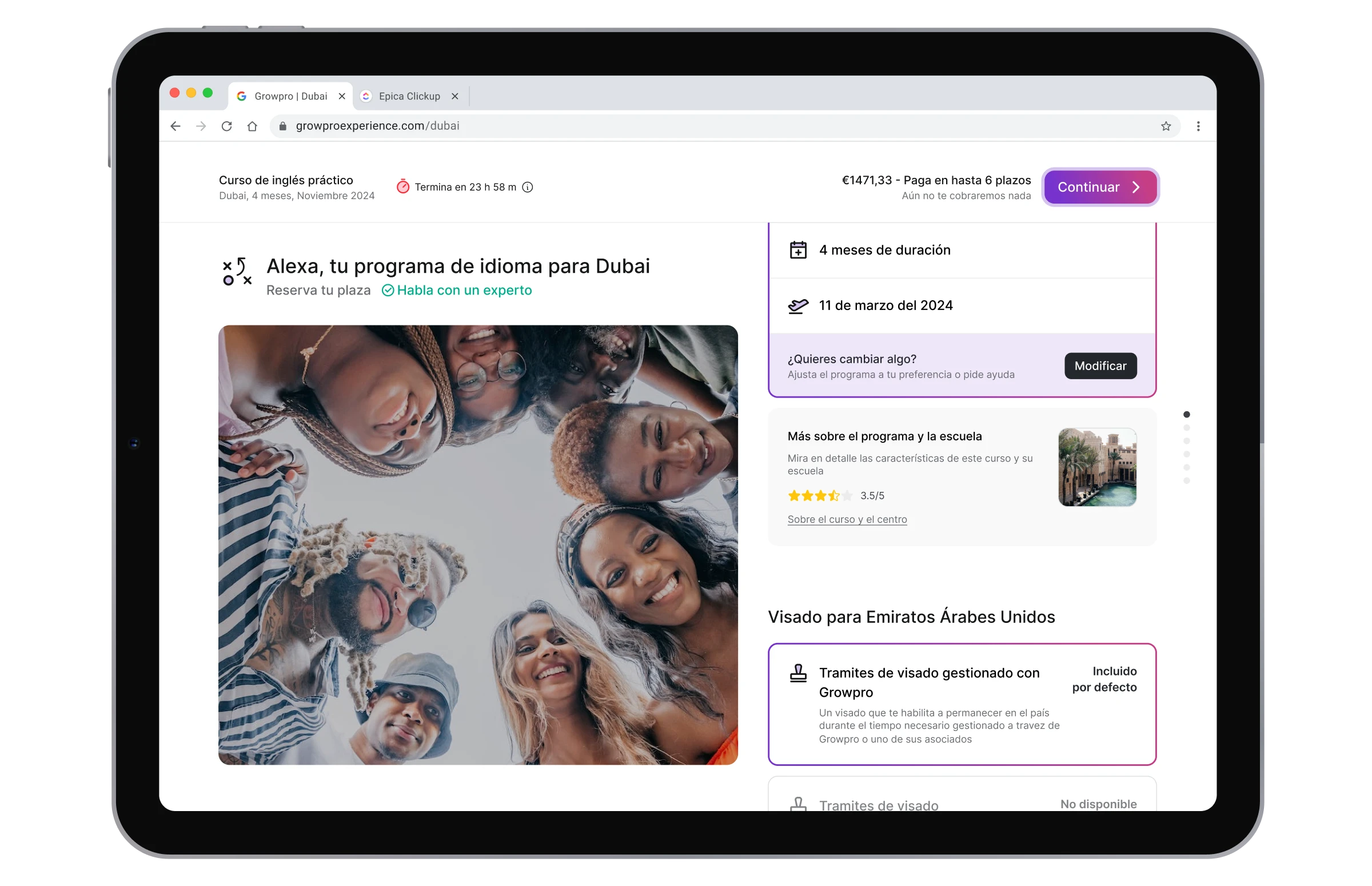
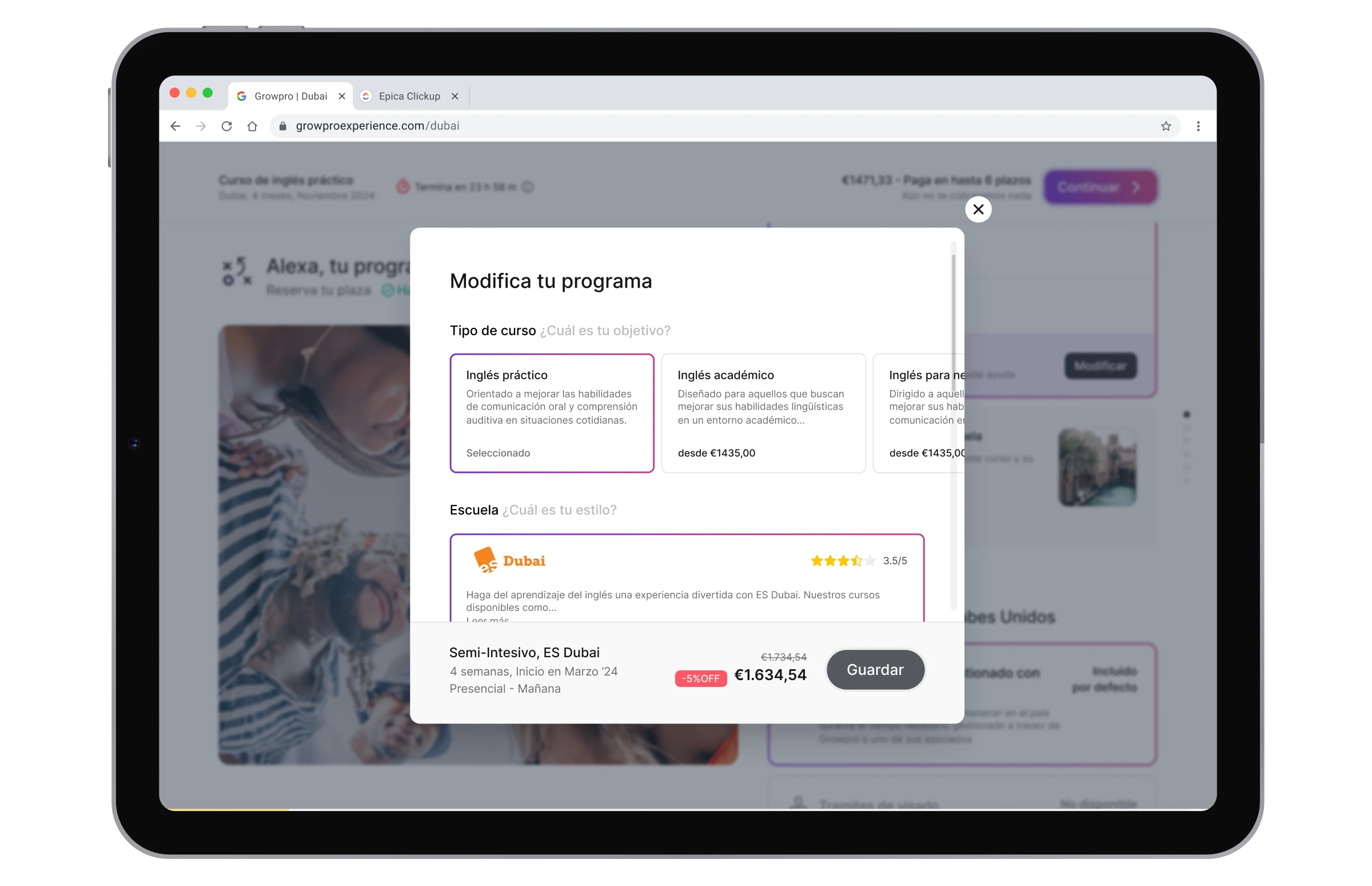
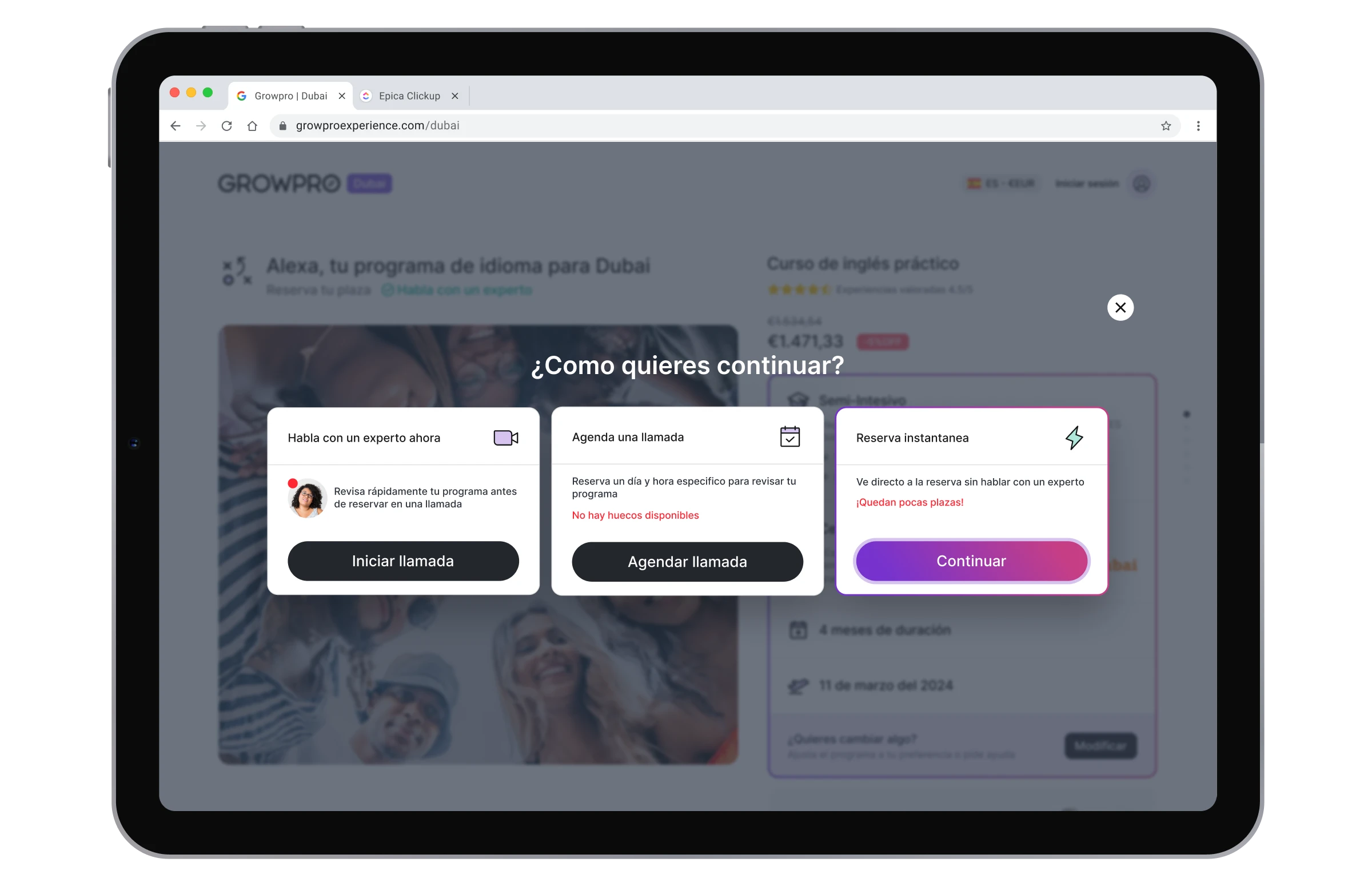
The student buys alone.
Every parameter comes from the student’s preference, not from our assumption, and the price updates as they choose.
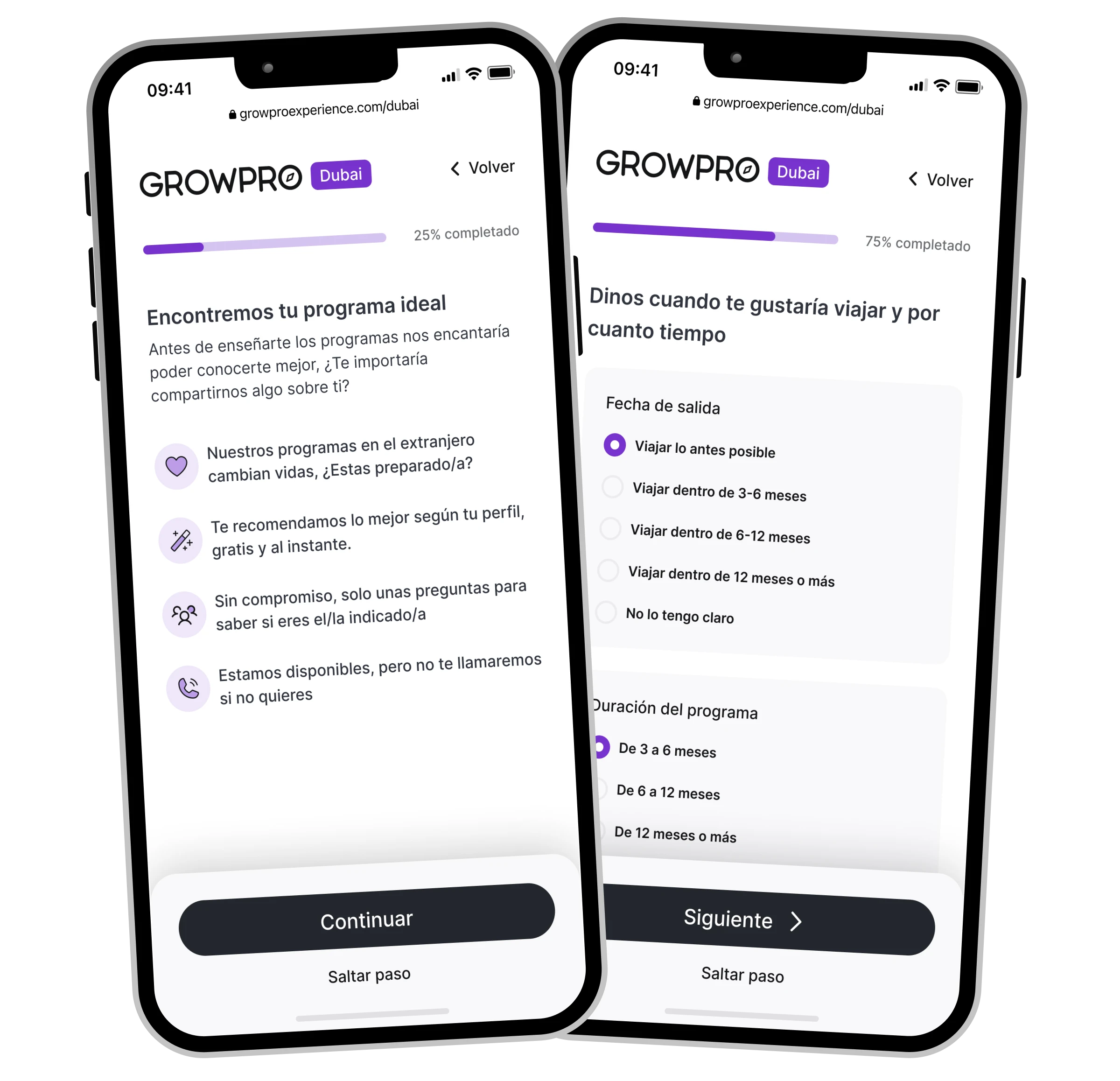
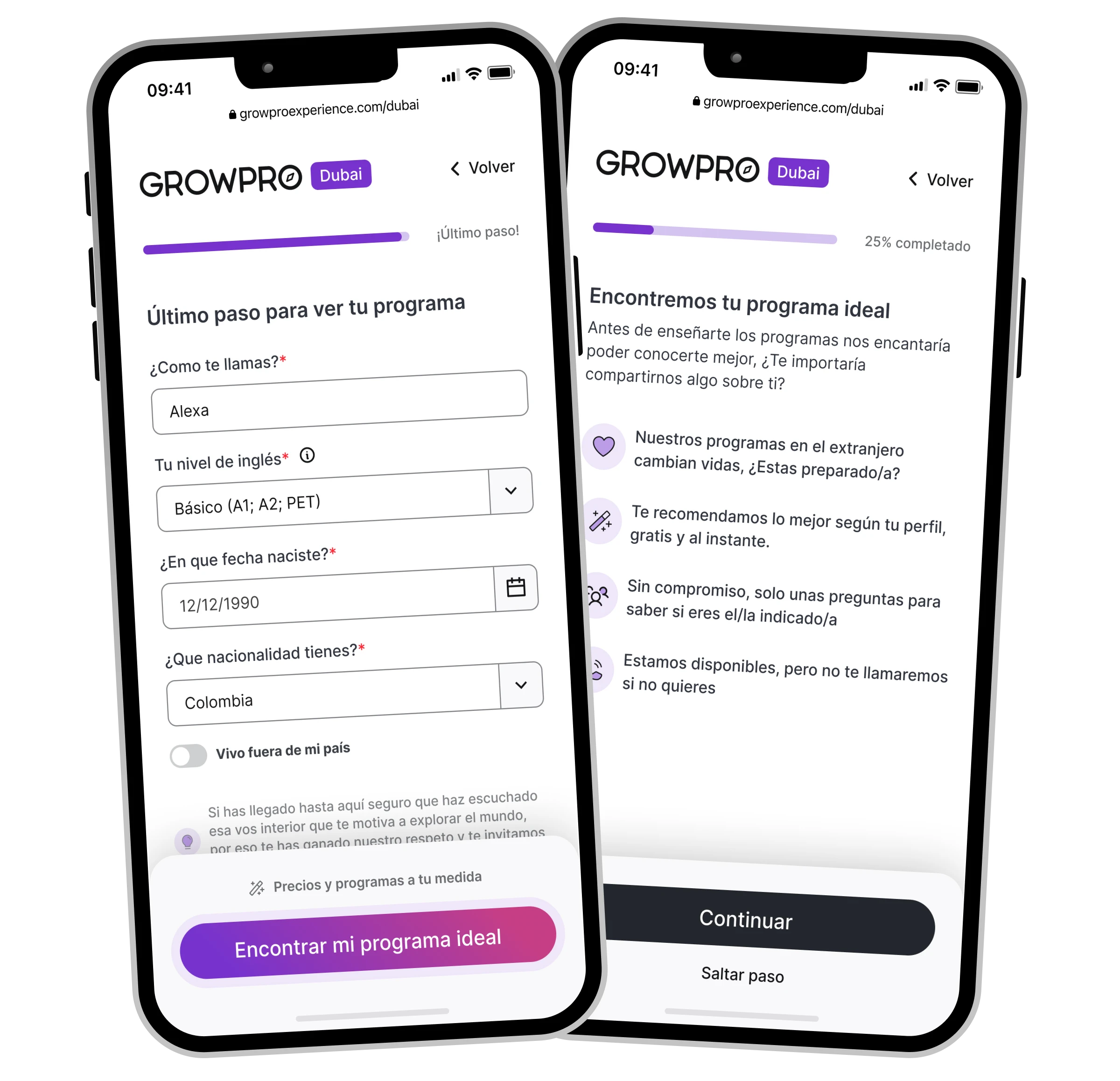
01 Qualify before proposing.
A few questions (what they’re after, when, their nationality) qualify the lead before any plan appears. We kept the lead score from the old qualifier: depending on how qualified they are, the storefront offers different ways forward, such as a call with an advisor or a place in a cohort.
02 Destination and country.
The destination follows what they want to live; the country is narrowed down by the visa they can apply for with their profile.
03 Course and schedule, by preference.
The course type follows their preferences, and so does the time of day: if they want to work in the morning, the plan offers afternoon courses.
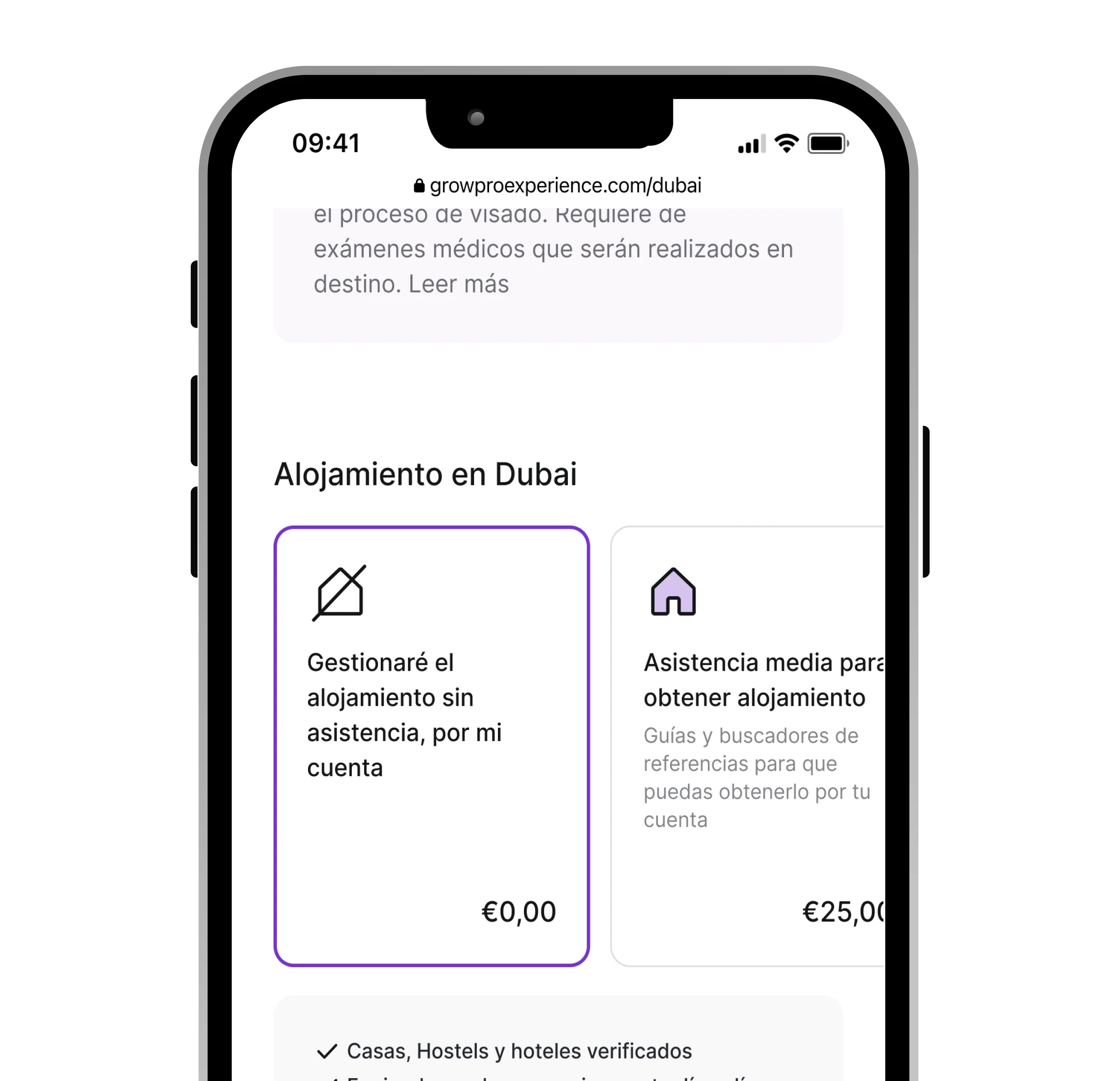
04 Accommodation up front, not after the sale.
Accommodation is a decisive pain. With GrowPro Houses it was solved from day one, in a cared-for setting, and some students picked a destination with GrowPro Houses over one without. It was a primary decision, so it moved into the storefront.
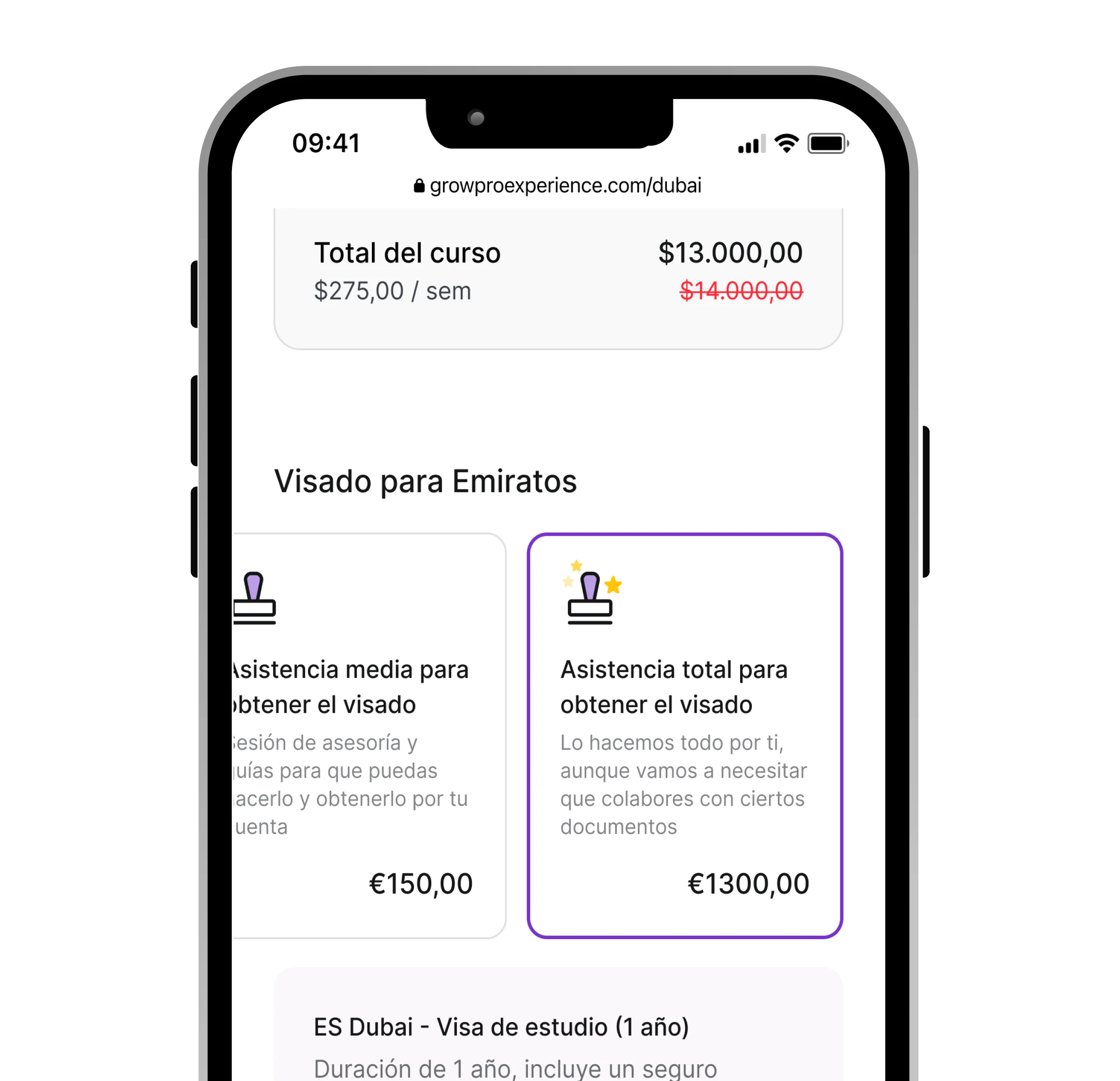
05 Visa and insurance.
The type of visa, how to apply for it and how urgent it is. Insurance or none, and whether the visa requires it.
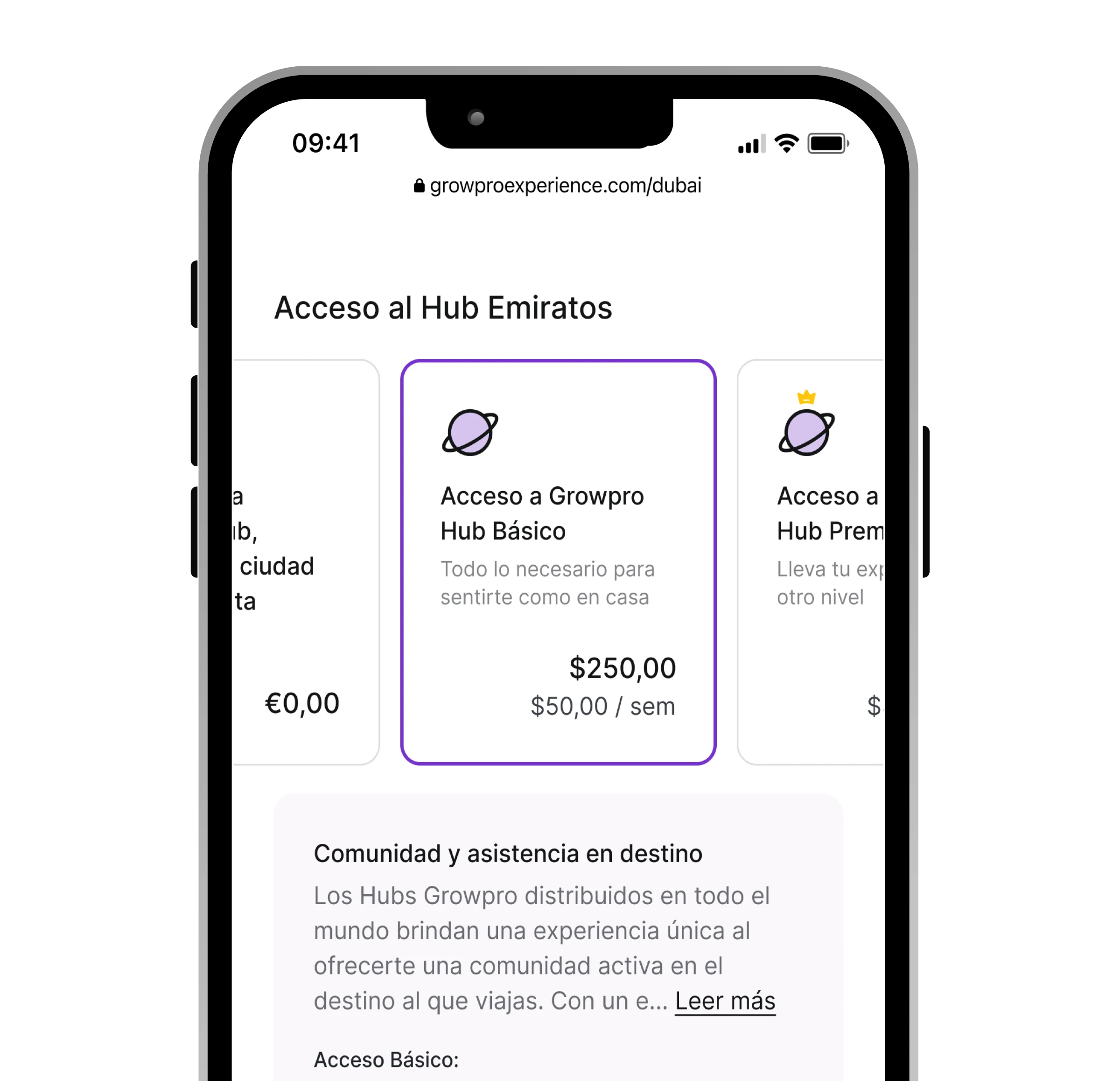
06 Everything included.
A SIM card and an airport pick-up: a complete experience from the moment you land.
The storefront became the advisor’s co-pilot.
The advisor ran the call on the storefront: the same page the student sees, with extra controls to negotiate the plan and guide onboarding until the booking closed. The proposal stopped being a document sent after the call and became the call itself. Fully bespoke plans kept an advisor-guided path.
| The advisor’s day before | With the storefront | |
|---|---|---|
| Quoting | Re-typing between CRM and quoting tool | One page, built with the student |
| Proposal | Sent cold, then edited over WhatsApp | Adjusted live on the call |
| Ramp-up | 6 months on eight tools | One tool to learn (target: 3 months) |
| Handover | Bookings and visas redo the data | Contract and payment close in the flow |
| Focus | Every case needs an advisor | Simple cases close alone; advisors take the complex ones |
05 Post-sale
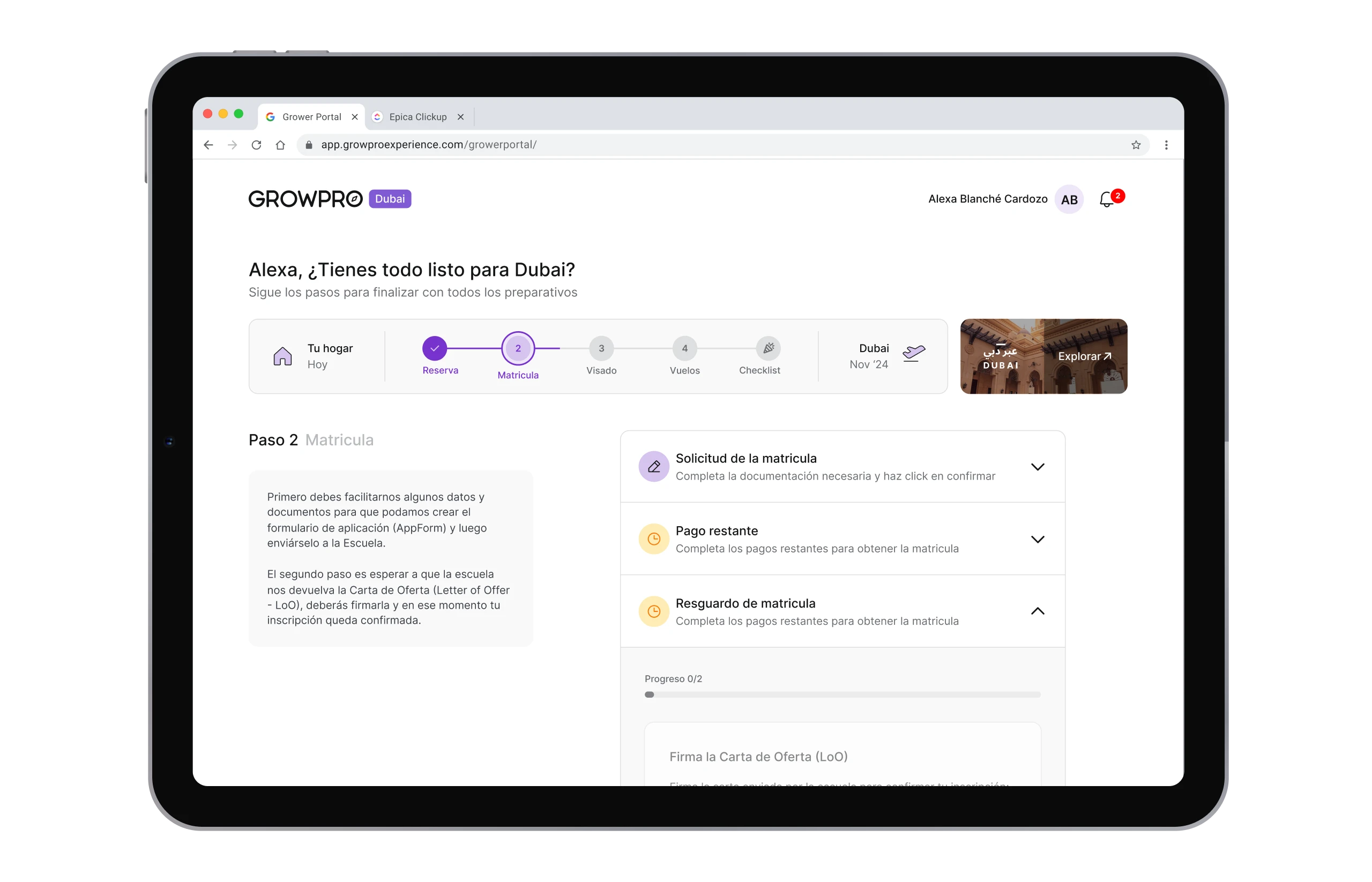
From signing to the flight, in one portal.
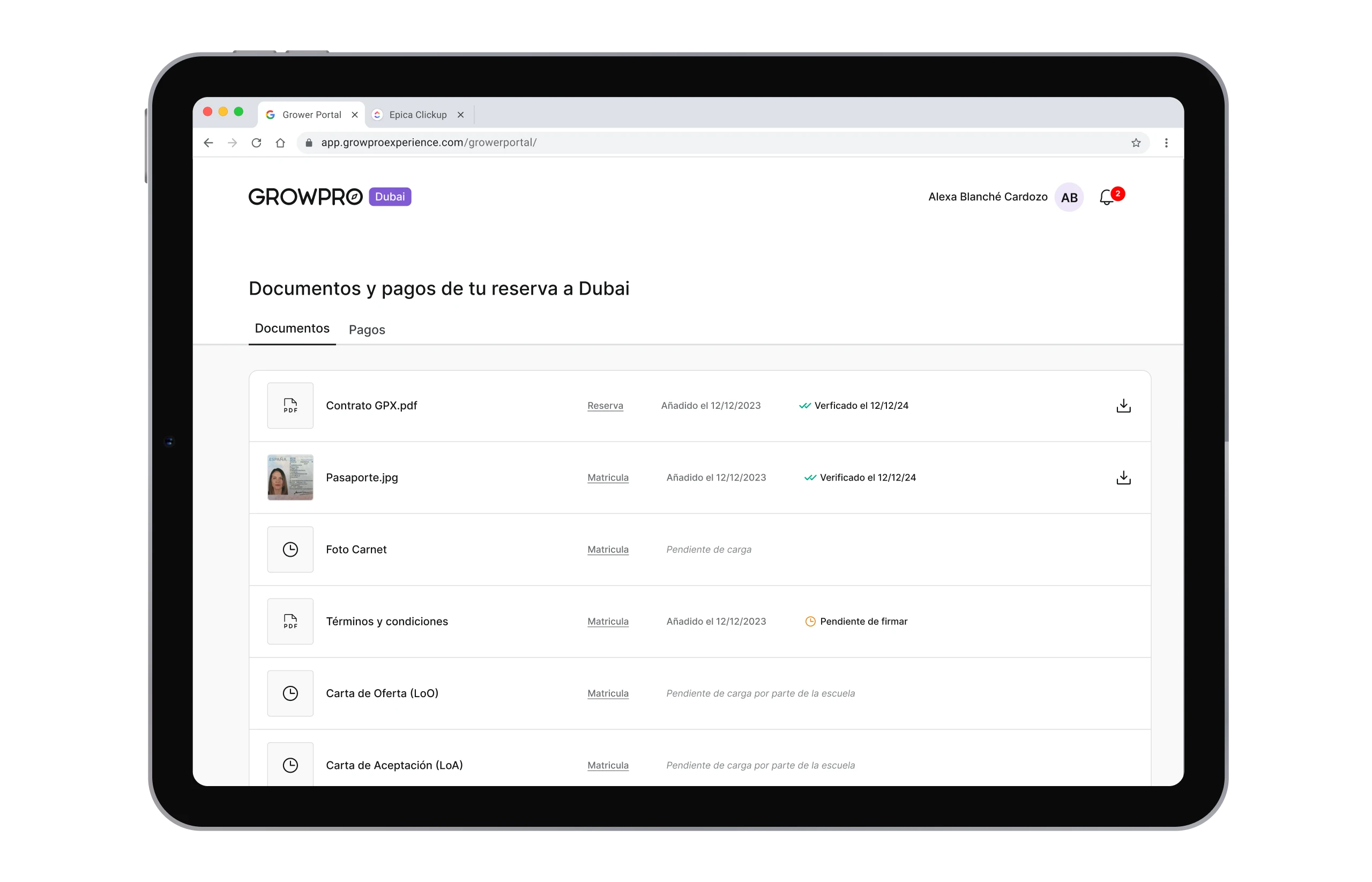
Once the plan was sold, every step before the trip had its own department. The travel portal holds it all: what’s done, what’s missing and what’s next, for GrowPro and agency students alike.

-
From the contract to the flight
-
Signed online, in the same flow as the plan.
-
Choosing how to pay, and the payment plan.
-
Each visa’s documents, translations and steps, tracked.
-
The policy, its status and documents.
-
School enrolment, no emails back and forth.
-
The Experience Pack nobody understood became the HUB: training, local jobs, 24/7 support, community and GrowPro houses on landing.
-
A final checklist before travelling.
-
06 B2B
One catalog, two kinds of partners.
GPX opened the catalog to two kinds of partners: agencies that sell it and providers that feed it. A SaaS-like network: one catalog, three ways in.
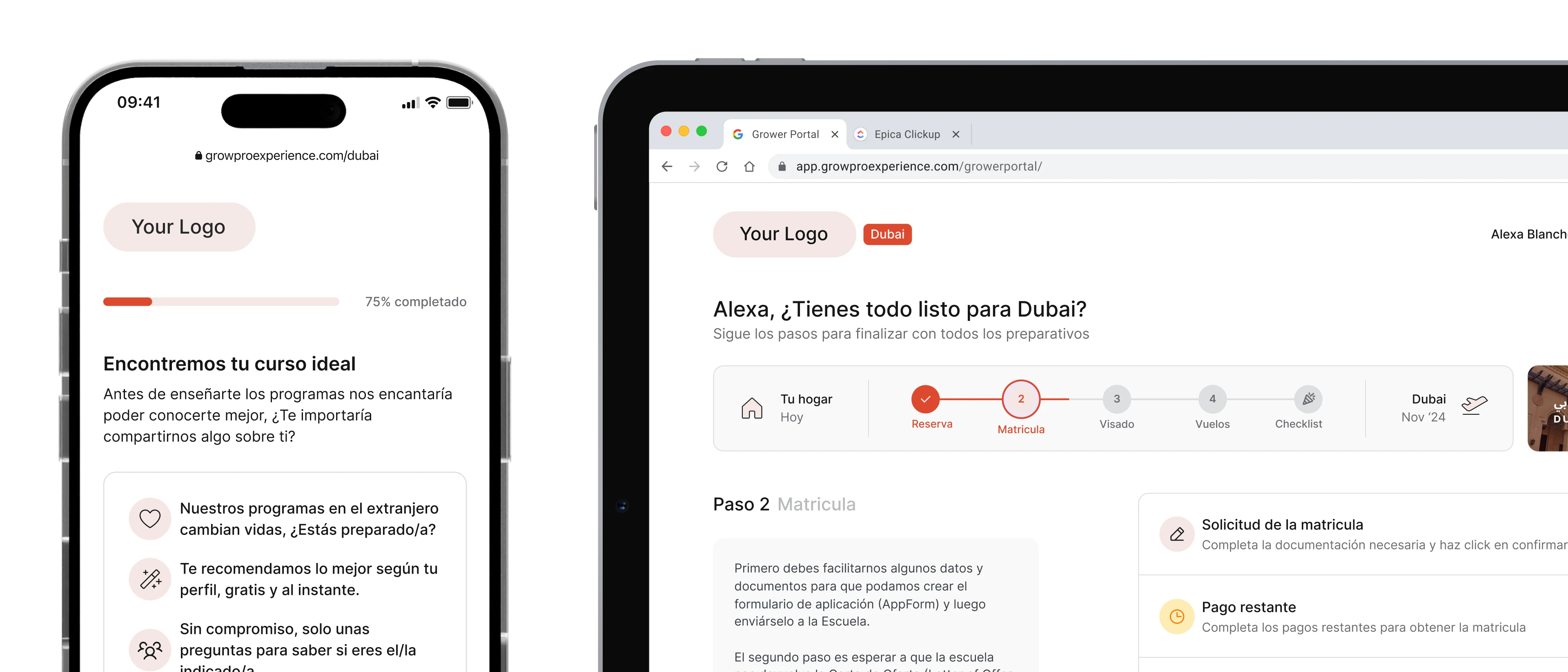
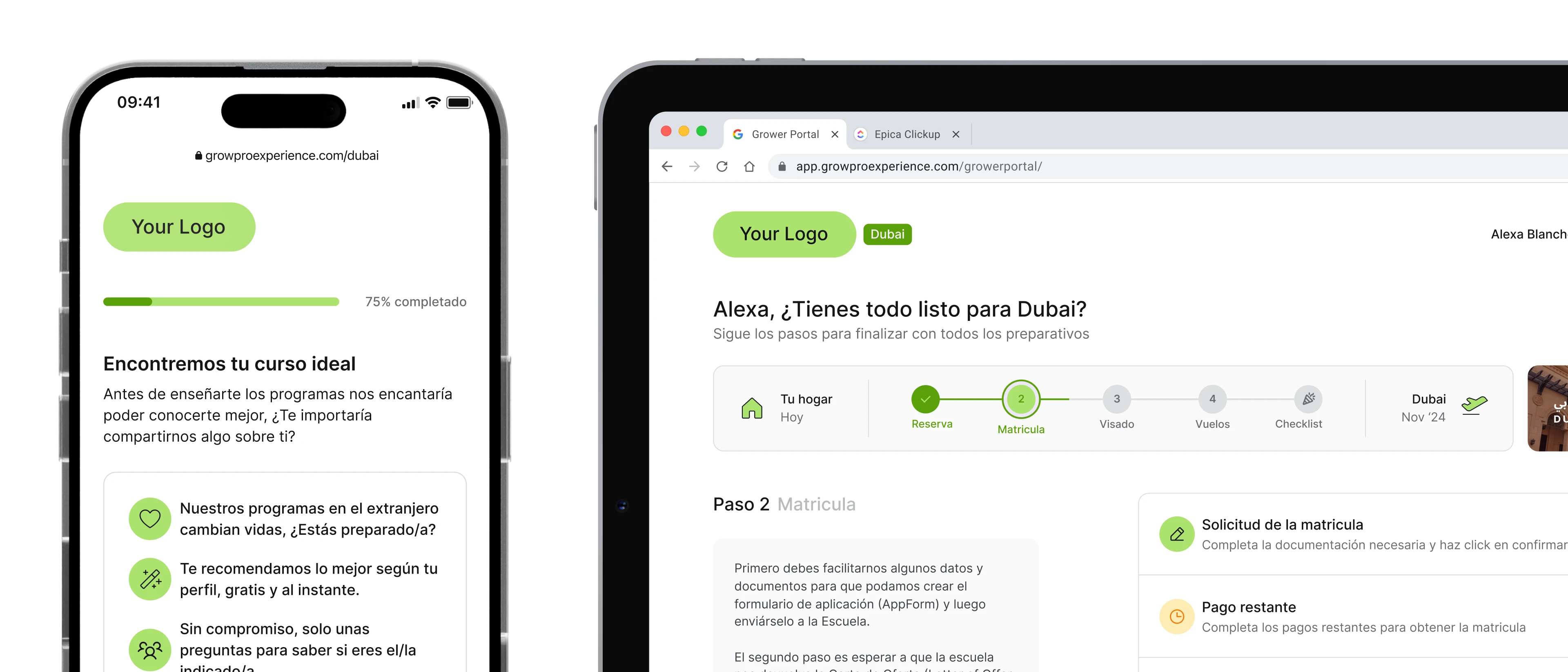
Agencies sell the full catalog under their own brand.
Partner agencies got the storefront as GrowPro Agents, connected to their CRM. They stay out of GrowPro’s day-to-day and need no onboarding: the product explains itself. Focus on selling, we’ll do the rest.
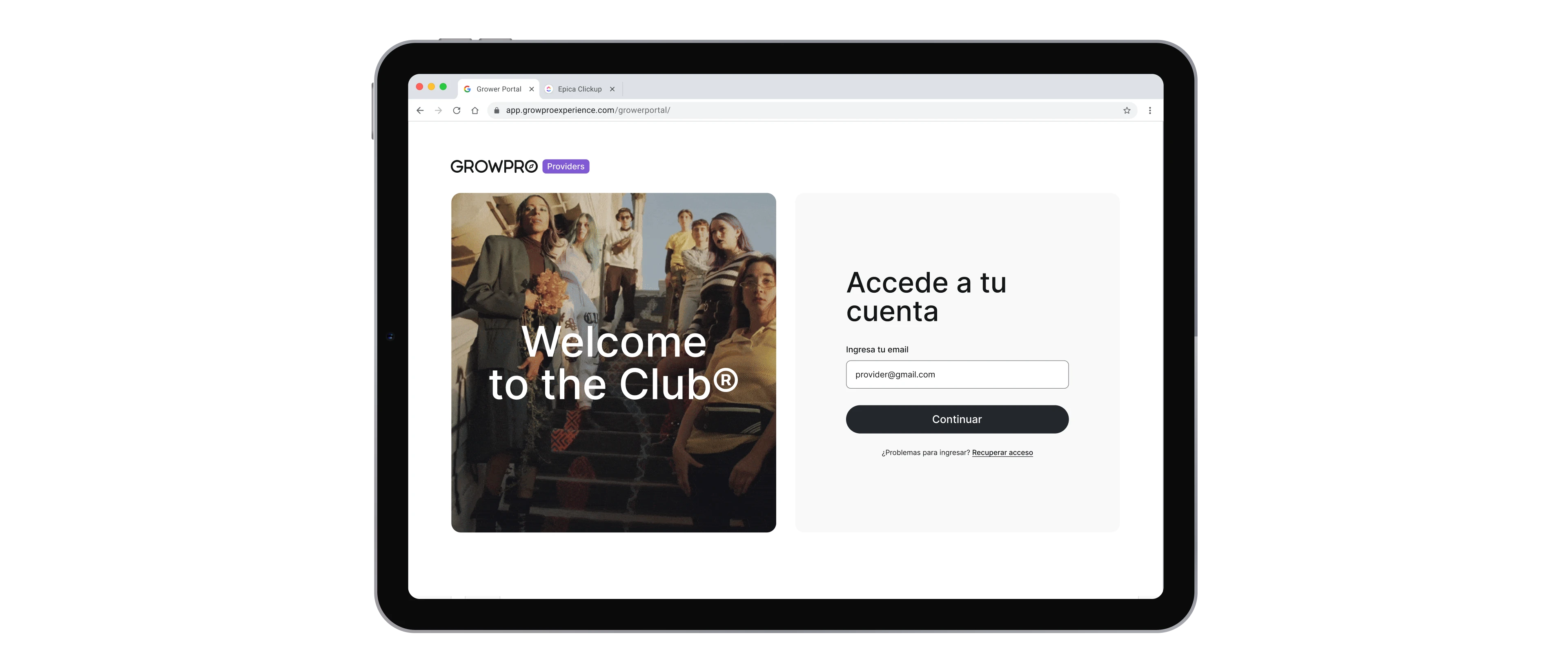
Providers run their own catalog, from sign-up to payout.
Providers feed the catalog from their own back office. GrowPro’s Supply and Ops teams only step in to check quality and manage bookings.
07 GTM and PMF
GTM and PMF expansion.
Moving 180 advisors and 30 agencies at once was one big bet. We split it into stages: a small first one, each opening the way for a bigger one.
Four cones along a timeline, each starting on the edge of the last one and changing course as it opens wider: Dubai, already running, then the sales team, agencies and providers, still to come.
The MVP: a new market, a new team.
Dubai’s advisors worked on the new storefront from the start, with no years of habits on the old tools to unlearn. The usability tests and the MVP’s funnel turned their friction, and the students’, into each iteration before the model opened to the rest of the business.
-
Why Dubai
New destination, an offer easy to bring in, and a team without old-tool habits.
-
Learn before scaling
Semi-moderated usability tests set the fixes before opening it further.
Then, the 180 advisors who already sold.
While Dubai proved the model, the rest of the business kept selling as before. Then the advisors moved over in batches, and self-service took the simple cases off their desks.
-
Old and new, side by side
Dubai ran the full model; the rest kept selling on the old tools.
-
How to migrate
Dubai showed how to bring them over: by booking type or by destination.
-
B2C: Self-service
Simple cases close alone; advisors take the complex ones.
Last, the network.
With the advisors on board, the same catalog opened outwards: first to partner agencies, then to the providers who feed it.
-
B2B: Agencies
Market expansion through agencies.
-
Providers
Efficient scale: providers manage their own catalog.
08 Metrics
Where we started, and where we aimed.
The old, already-optimised tools set the benchmark. Every figure is a target, except the one marked Result.
09 Learnings
Going product-led doesn’t remove the salesperson. It removes the black box.
The problem was never the advisors; it was the opacity. Once both looked at the same plan, weeks of back-and-forth fitted on one page.
How we measured and iterated
An AARRR funnel from day one, semi-moderated usability tests and a qualitative review of each funnel step. Every iteration came from those numbers.
What I’d do again
Listen to the calls before designing the catalog, and start where the change was easiest to prove.